
🚀 Production-Ready Async Proxy Management
The modernized, actively-maintained successor to ProxyBroker (v0.3.2, abandoned 2018) — Python 3.10-3.14, comprehensive test coverage, first-class IPv6.




ProxyBroker2 is an open source tool that asynchronously finds public proxies from 50+ sources, validates them against judge servers, and can operate as a rotating proxy server.
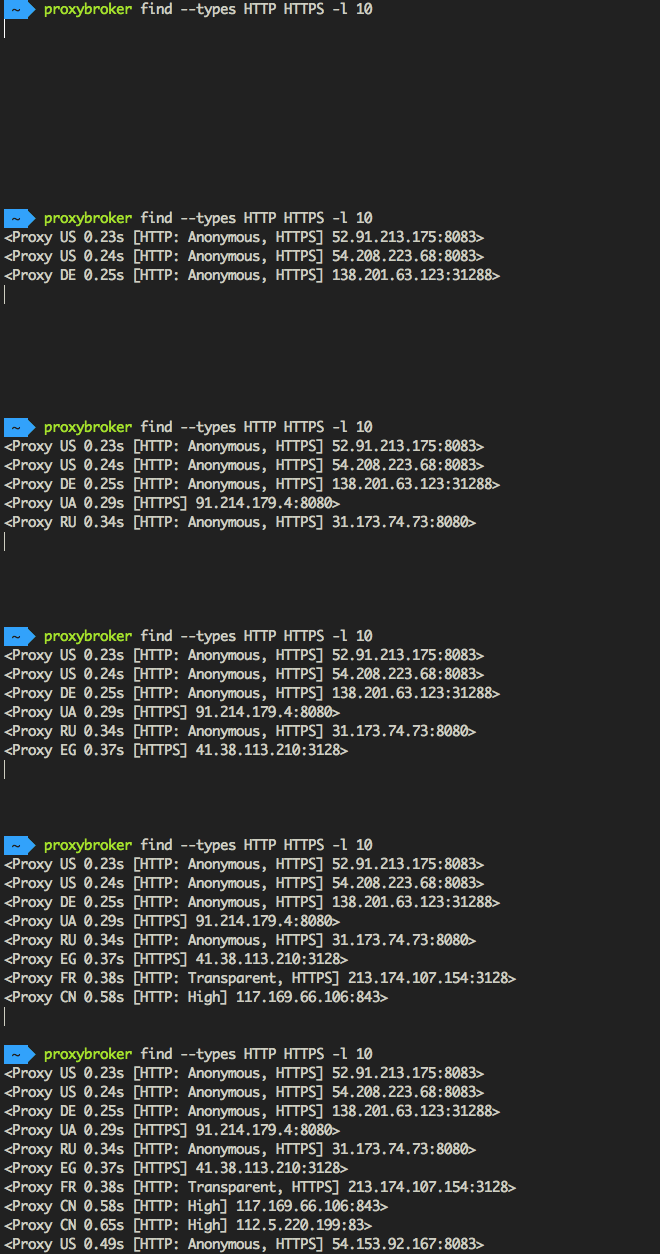
- Finds more than 7000 working proxies from ~50 sources.
- Support protocols: HTTP(S), SOCKS4/5. Also CONNECT method to ports 80 and 23 (SMTP).
- Proxies may be filtered by type, anonymity level, response time, country and status in DNSBL.
- Work as a proxy server that distributes incoming requests to external proxies. With automatic proxy rotation.
- All proxies are checked to support Cookies and Referer (and POST requests if required).
- Automatically removes duplicate proxies.
- Is asynchronous.
ProxyBroker2 is the actively-maintained successor to the original ProxyBroker (v0.3.2), which was abandoned in 2018. We've modernized the stack and added significant new capabilities while keeping the Python API compatible.
- Active maintenance — regular security updates and feature work
- Modern Python support — Python 3.10-3.14 (v0.3.2 was Python 3.5+ only)
- Zero critical bugs — fixed deadlocks, memory leaks, signal handler leaks, race conditions that existed in v0.3.2
- First-class IPv6 — RFC 5952 canonical form, SOCKS5
ATYP=0x04, bracketed URI authority. v0.3.2 was IPv4-only. - Custom providers — drop YAML/JSON config files into a folder, no code required (see Custom Proxy Providers below)
- Modern async patterns — updated from deprecated asyncio APIs; uses
asyncio.run,get_running_loop, etc. - Comprehensive testing — contract-based test suite that protects user-visible behavior across refactors (v0.3.2 had minimal testing)
- Better documentation — auto-generated API reference + hand-written guides on ReadTheDocs
- Protocols: HTTP, HTTPS, SOCKS4, SOCKS5, CONNECT:80, CONNECT:25
- Anonymity detection: Transparent / Anonymous / High
- 50+ proxy sources discovered asynchronously
- Proxy server mode with automatic rotation and failover
- Smart filtering by country, protocol, anonymity level, response time, DNSBL
Docker Hub https://hub.docker.com/r/bluet/proxybroker2
# Pull the image
$ docker pull bluet/proxybroker2

# Run with --help to see all options
$ docker run --rm bluet/proxybroker2 --help- Python 3.10-3.14
That's it — all Python dependencies are installed automatically by pip / Poetry / uv.
For building the standalone executable (see pyinstaller build), you'll also need upx and binutils.
⚠️ WARNING: Do not install from PyPI. Bothproxybroker(the abandoned v0.3.2) and theproxybroker2name on PyPI have been squatted by unrelated/unauthorized publishers (see #186, pypi/support#10315). Install only from this GitHub repository.
Install the latest version (via pip):
# Install latest from default branch
$ pip install -U git+https://github.com/bluet/proxybroker2.git
For a specific stable release, append @<tag> from the Releases page — e.g.:
$ pip install -U git+https://github.com/bluet/proxybroker2.git@<tag>
Or install with uv (supported as alternative)
uv reads the same git URL pip does — under the hood, uv invokes the project's build backend (poetry-core) to produce a wheel with full PEP 621 metadata:
# Add to a uv-managed project
uv add "proxybroker2 @ git+https://github.com/bluet/proxybroker2.git"

# Or install into the current venv
uv pip install git+https://github.com/bluet/proxybroker2.git
$ docker pull bluet/proxybroker2
Supported Operating System: Windows, Linux, MacOS
On UNIX-like systems (Linux / macOSX / BSD)
Install these tools
- upx
- objdump (this tool is usually in the binutils package)
$ sudo apt install -y upx-ucl binutils # On Ubuntu / Debian
pip install pyinstaller \
&& pip install . \
&& mkdir -p build \
&& cd build \
&& pyinstaller --onefile --name proxybroker --add-data "../proxybroker/data:data" --workpath ./tmp --distpath . --clean ../py2exe_entrypoint.py \
&& rm -rf tmp *.spec
The executable is now in the build directory
After installation, you can immediately start finding proxies:
# Find 5 working HTTP proxies
$ python -m proxybroker find --types HTTP --limit 5

# Find 10 US HTTP proxies
$ python -m proxybroker find --types HTTP --countries US --limit 10

# Run local proxy server on port 8888
$ python -m proxybroker serve --host 127.0.0.1 --port 8888 --types HTTP HTTPS
Run python -m proxybroker --help for full options.
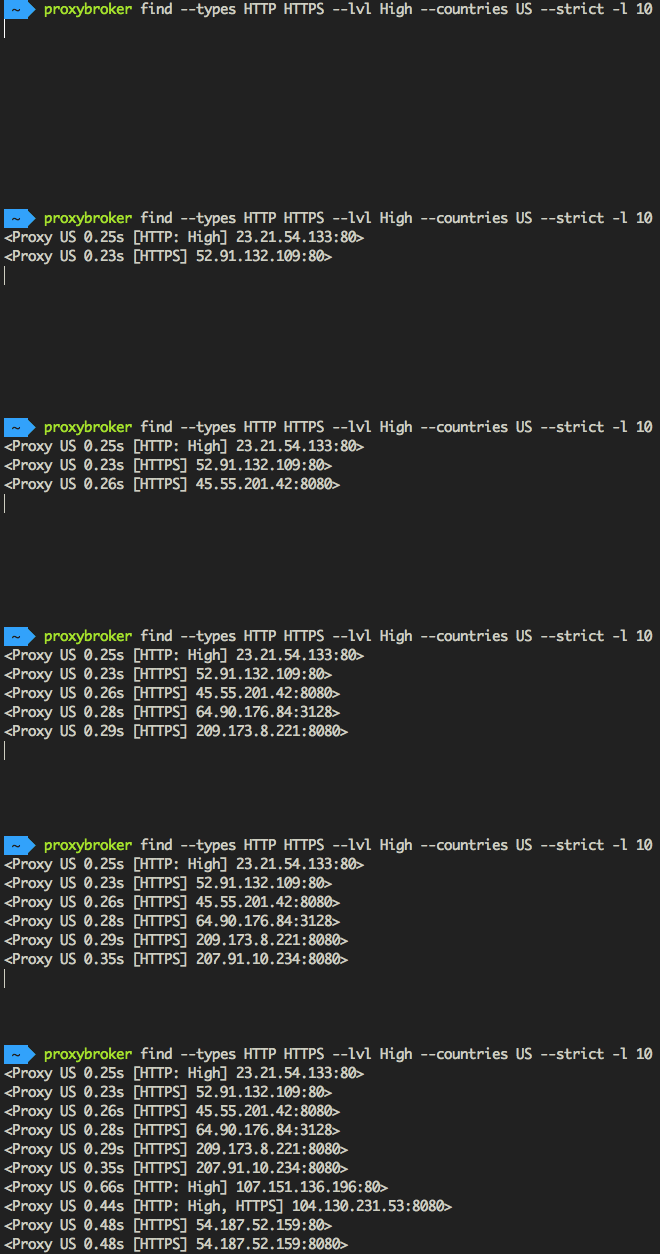
Find and show 10 HTTP(S) proxies from United States with the high level of anonymity:
$ python -m proxybroker find --types HTTP HTTPS --lvl High --countries US --strict -l 10
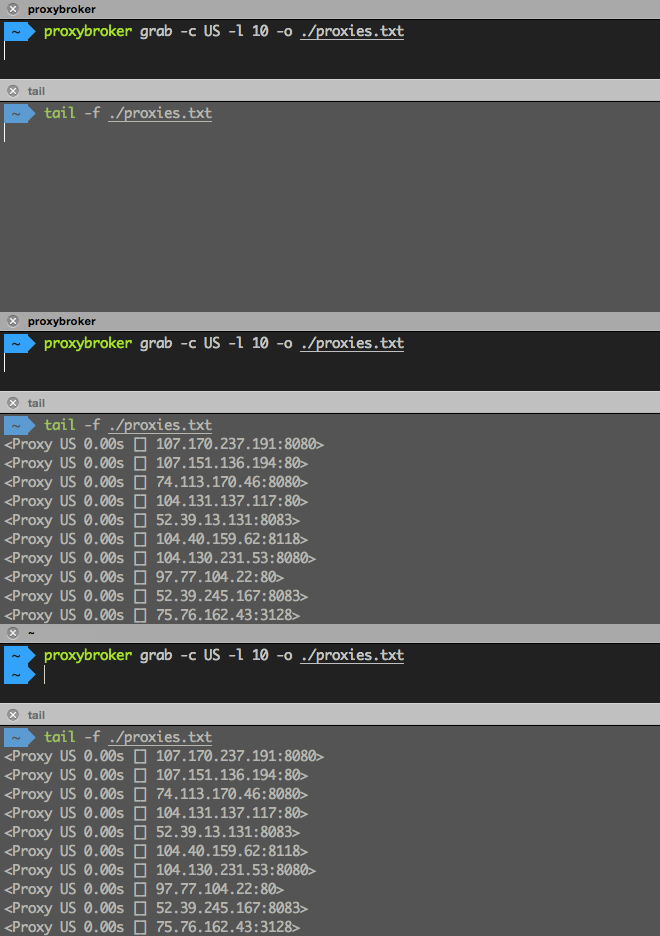
Find and save to a file 10 US proxies (without a check):
$ python -m proxybroker grab --countries US --limit 10 --outfile ./proxies.txt
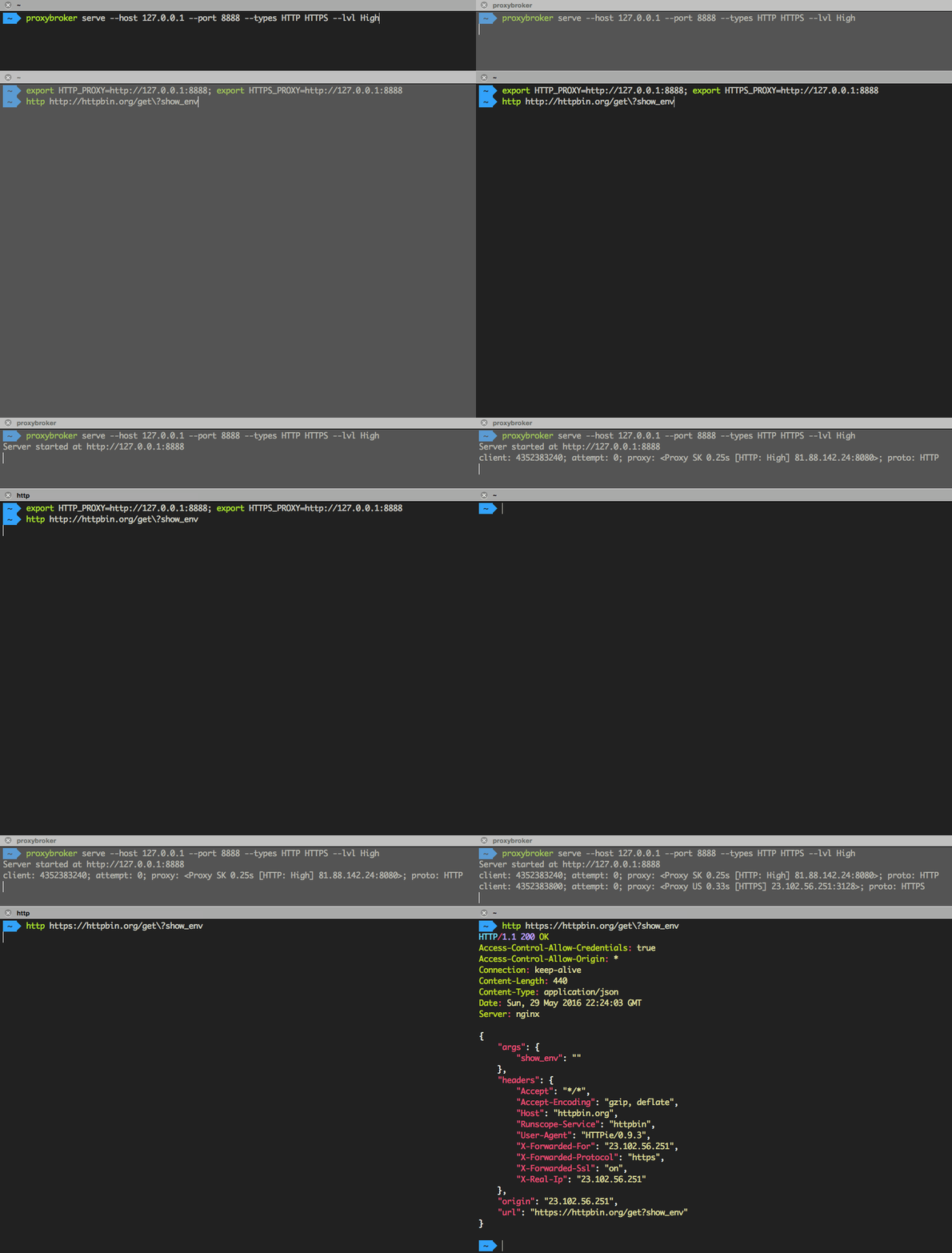
Run a local proxy server that distributes incoming requests to a pool of found HTTP(S) proxies with the high level of anonymity:
$ python -m proxybroker serve --host 127.0.0.1 --port 8888 --types HTTP HTTPS --lvl High --min-queue 5
Run python -m proxybroker --help for more information on the options available.
Run python -m proxybroker <command> --help for more information on a command.
Find and show 10 working HTTP(S) proxies:
import asyncio
from proxybroker import Broker

async def show(proxies):
    while True:
        proxy = await proxies.get()
        if proxy is None:
            break
        print("Found proxy: %s" % proxy)

async def main():
    proxies = asyncio.Queue()
    broker = Broker(proxies)
    await asyncio.gather(
        broker.find(types=["HTTP", "HTTPS"], limit=10),
        show(proxies)
    )

if __name__ == "__main__":
    asyncio.run(main())
Add your own proxy sources without modifying the codebase. Two paths:
Drop YAML/JSON config files into a folder, bind-mount it to /configs:
# ~/proxy-sources/my_list.yaml
name: My Internal Source
type: simple
url: https://my-server.example.com/proxies.txt
format: text
protocols: [HTTP, HTTPS]
docker run --rm \
-v ~/proxy-sources:/configs \
bluet/proxybroker2 \
find --types HTTP --limit 10The CLI also accepts --provider-dir PATH (repeatable) and reads $PROXYBROKER_PROVIDER_DIR if neither is set.
from proxybroker import SimpleProvider, Broker

class MyProvider(SimpleProvider):
    domain = "mysite.com"

    def __init__(self):
        super().__init__(
            url="http://mysite.com/proxies.txt",
            format='text',
            proto=('HTTP', 'HTTPS')
        )

broker = Broker(providers=[MyProvider()])
Full documentation on custom providers
ProxyBroker2 implements a comprehensive contract-based testing strategy that ensures reliability while enabling innovation:
- User-visible behavior - "Does proxy finding work?" vs internal algorithms
- API signatures - Method parameters and return types users depend on
- Protocol support - HTTP, HTTPS, SOCKS4/5 compatibility
- Error contracts - Exception types and error handling behavior
- Internal algorithms - Allow optimization without breaking tests
- Exact protocol bytes - Enable protocol improvements and IPv6 support
- Provider specifics - Adapt to website changes without test failures
- Performance metrics - Implementation details that can evolve
This approach protects your code from breaking changes while allowing ProxyBroker2 to continuously improve its internals.
Check X-Proxy-Info header in response.
$ http_proxy=http://127.0.0.1:8888 https_proxy=http://127.0.0.1:8888 curl -v http://httpbin.org/get
*   Trying 127.0.0.1...
* TCP_NODELAY set
* Connected to 127.0.0.1 (127.0.0.1) port 8888 (#0)
> GET http://httpbin.org/get HTTP/1.1
> Host: httpbin.org
> User-Agent: curl/7.58.0
> Accept: */*
> Proxy-Connection: Keep-Alive
>
< HTTP/1.1 200 OK
< X-Proxy-Info: 174.138.42.112:8080
< Date: Mon, 04 May 2020 03:39:40 GMT
< Content-Type: application/json
< Content-Length: 304
< Server: gunicorn/19.9.0
< Access-Control-Allow-Origin: *
< Access-Control-Allow-Credentials: true
< X-Cache: MISS from ADM-MANAGER
< X-Cache-Lookup: MISS from ADM-MANAGER:880
< Connection: keep-alive
<
{
  "args": {},
  "headers": {
    "Accept": "*/*",
    "Cache-Control": "max-age=259200",
    "Host": "httpbin.org",
    "User-Agent": "curl/7.58.0",
    "X-Amzn-Trace-Id": "Root=1-5eaf8e7c-6a1162a1387a1743a49063f4"
  },
  "origin": "...",
  "url": "http://httpbin.org/get"
}
* Connection #0 to host 127.0.0.1 left intact
We are not able to modify HTTPS traffic to inject custom header once they start being encrypted. A X-Proxy-Info will be sent to client after HTTP/1.1 200 Connection established but not sure how clients can read it.
(env) bluet@ocisly:~/workspace/proxybroker2$ http_proxy=http://127.0.0.1:8888 https_proxy=http://127.0.0.1:8888 curl -v https://httpbin.org/get
*   Trying 127.0.0.1...
* TCP_NODELAY set
* Connected to 127.0.0.1 (127.0.0.1) port 8888 (#0)
* allocate connect buffer!
* Establish HTTP proxy tunnel to httpbin.org:443
> CONNECT httpbin.org:443 HTTP/1.1
> Host: httpbin.org:443
> User-Agent: curl/7.58.0
> Proxy-Connection: Keep-Alive
>
< HTTP/1.1 200 Connection established
< X-Proxy-Info: 207.148.22.139:8080
<
* Proxy replied 200 to CONNECT request
* CONNECT phase completed!
* ALPN, offering h2
* ALPN, offering http/1.1
* successfully set certificate verify locations:
...
*  SSL certificate verify ok.
* Using HTTP2, server supports multi-use
* Connection state changed (HTTP/2 confirmed)
* Copying HTTP/2 data in stream buffer to connection buffer after upgrade: len=0
* Using Stream ID: 1 (easy handle 0x5560b2e93580)
> GET /get HTTP/2
> Host: httpbin.org
> User-Agent: curl/7.58.0
> Accept: */*
>
* Connection state changed (MAX_CONCURRENT_STREAMS updated)!
< HTTP/2 200
< date: Mon, 04 May 2020 03:39:35 GMT
< content-type: application/json
< content-length: 256
< server: gunicorn/19.9.0
< access-control-allow-origin: *
< access-control-allow-credentials: true
<
{
  "args": {},
  "headers": {
    "Accept": "*/*",
    "Host": "httpbin.org",
    "User-Agent": "curl/7.58.0",
    "X-Amzn-Trace-Id": "Root=1-5eaf8e77-efcb353b0983ad6a90f8bdcd"
  },
  "origin": "...",
  "url": "https://httpbin.org/get"
}
* Connection #0 to host 127.0.0.1 left intact
For HTTP, it's easy.
$ http_proxy=http://127.0.0.1:8888 https_proxy=http://127.0.0.1:8888 curl -v http://proxycontrol/api/history/url:http://httpbin.org/get
*   Trying 127.0.0.1...
* TCP_NODELAY set
* Connected to 127.0.0.1 (127.0.0.1) port 8888 (#0)
> GET http://proxycontrol/api/history/url:http://httpbin.org/get HTTP/1.1
> Host: proxycontrol
> User-Agent: curl/7.58.0
> Accept: */*
> Proxy-Connection: Keep-Alive
>
< HTTP/1.1 200 OK
< Content-Type: application/json
< Content-Length: 34
< Access-Control-Allow-Origin: *
< Access-Control-Allow-Credentials: true
<
{"proxy": "..."}
For HTTPS, we're not able to know encrypted payload (request), so only hostname can be used.
$ http_proxy=http://127.0.0.1:8888 https_proxy=http://127.0.0.1:8888 curl -v http://proxycontrol/api/history/url:httpbin.org:443
*   Trying 127.0.0.1...
* TCP_NODELAY set
* Connected to 127.0.0.1 (127.0.0.1) port 8888 (#0)
> GET http://proxycontrol/api/history/url:httpbin.org:443 HTTP/1.1
> Host: proxycontrol
> User-Agent: curl/7.58.0
> Accept: */*
> Proxy-Connection: Keep-Alive
>
< HTTP/1.1 200 OK
< Content-Type: application/json
< Content-Length: 34
< Access-Control-Allow-Origin: *
< Access-Control-Allow-Credentials: true
<
{"proxy": "..."}
* Connection #0 to host 127.0.0.1 left intact
$ http_proxy=http://127.0.0.1:8888 https_proxy=http://127.0.0.1:8888 curl -v http://proxycontrol/api/remove/PROXY_IP:PROXY_PORT
*   Trying 127.0.0.1...
* TCP_NODELAY set
* Connected to 127.0.0.1 (127.0.0.1) port 8888 (#0)
> GET http://proxycontrol/api/remove/... HTTP/1.1
> Host: proxycontrol
> User-Agent: curl/7.58.0
> Accept: */*
> Proxy-Connection: Keep-Alive
>
< HTTP/1.1 204 No Content
<
* Connection #0 to host 127.0.0.1 left intact
If you're upgrading from the original ProxyBroker v0.3.2, here are the key changes:
Python Version
# v0.3.2: Python 3.5.3+ supported
# v2.0.0+: Python 3.10+ required
python --version  # Must be 3.10+
Installation
# v0.3.2: pip install proxybroker
# v2.0.0+: Install from GitHub (original is abandoned, PyPI name is squatted)
pip uninstall proxybroker  # Remove old version if installed
pip install git+https://github.com/bluet/proxybroker2.git
CLI Usage
# v0.3.2: proxybroker find --types HTTP --limit 10
# v2.0.0+: python -m proxybroker find --types HTTP --limit 10The Python API remains largely compatible:
# This code works in both versions
import asyncio
from proxybroker import Broker

async def main():
    proxies = asyncio.Queue()
    broker = Broker(proxies)
    await broker.find(types=['HTTP'], limit=10)

asyncio.run(main())  # Modern async pattern
For what ProxyBroker2 adds over v0.3.2, see What's New in ProxyBroker2 above.
📚 Complete Documentation: https://proxybroker2.readthedocs.io/
- Auto-generated API reference (from docstrings)
- Hand-written guides: installation, tutorials, architecture
- Hosted on ReadTheDocs in HTML / PDF / downloadable formats
See open issues for active work and ideas:
- Authentication features (SOCKS5 auth, HTTP Basic auth)
- TLS hardening (cert pinning, ECH, TLS 1.3-only)
- All open issues
We welcome contributions! The project has comprehensive test coverage and development tooling.
-
Install Poetry if you don't have it (canonical dev tool):
curl -sSL https://install.python-poetry.org | python3 - -
Clone and setup:
git clone https://github.com/yourusername/proxybroker2.git
cd proxybroker2
poetry install  # Installs runtime + dev deps (including ruff, pytest)
Alternative: use uv as a command runner
Poetry remains the canonical dev tool —
poetry.lockis the lockfile CI tests against. This repo currently uses Poetry metadata ([tool.poetry]) without a[project]table, souv syncis not supported here. If you prefer uv ergonomics, install deps with Poetry first and then point uv at Poetry's environment (plainuv runwould look for a[project]table and use its own environment instead):poetry install poetry run pytest # canonical uv run --no-project --python "$(poetry env info --executable)" pytest # same env, uv as the runner
Full uv migration remains deferred until snyk supports
uv.locknatively (snyk-python-plugin#251).
- Create your feature branch:
git checkout -b my-new-feature - Make changes and format:
# Auto-format code (required before commit)
poetry run ruff check . --fix && poetry run ruff format .

# Run tests to ensure everything works
poetry run pytest tests/ -v
- Commit with Conventional Commits format:
git commit -m "feat: add SOCKS5 authentication support"
git commit -m "fix: resolve memory leak in proxy pool"
git commit -m "docs: update installation instructions"
- Push to the branch:
git push origin my-new-feature - Submit a pull request!
The only tools you need to install yourself — everything else (ruff, pytest, pytest-asyncio, etc.) comes from poetry install:
- Poetry 2.x — canonical dependency manager (uv supported as alternative, see #105)
- pre-commit (optional) — run
pre-commit installafterpoetry installto auto-format/lint on every commit
For project architecture and design conventions, see CLAUDE.md.
Licensed under the Apache License, Version 2.0 — see LICENSE.

This product includes GeoLite2 data created by MaxMind, available from http://www.maxmind.com.
- constverum#161 — original PR thread where ProxyBroker2 emerged from the abandoned upstream.
Thanks goes to these wonderful people (emoji key):
 a5r0n 💻 |
 C.M. Yang 💻 🤔 👀 |
 Ivan Villareal 💻 |
 Quancore 💻 |
 Felipe 🤔 |
 vincentinttsh 💻 👀 |
 Ziloka 💻 |
 hms5232 💻 |
 Stefan Machmeier 💻 |
 steven 📖 |
This project follows the all-contributors specification. Contributions of any kind welcome!