

The fastest binary serializer for C#.
General-purpose, source-generated, zero-allocation and thread-safe: for services, RPC,
messaging, caching and storage on .NET, with Unity, Godot and HybridCLR support.


🌐 Website · 🚀 Getting Started · What's new in v4 · Benchmarks · vs MemoryPack · 中文
Up to 6.8× faster serialization and up to 8.7× faster in-place deserialization than MemoryPack
Zero GC allocations on hot paths · 221× faster builds than v3
Important
Nino is built to read untrusted data: messages from network peers, files users hand you, request bodies.
Crafted bytes cannot crash the process, read past the input, allocate out of proportion to their size (a
collection allocates at most 16× the bytes left ahead of its elements) or name a type to create: the data holds
type ids of your declared subtypes, never type names. Every invalid input throws one exception,
NinoDataException (an InvalidOperationException, message starting Nino:), so a single catch at the boundary
handles it. Keys built to collide in a hash table throw too (NinoSettings.MaxHashCollisions), and
NinoSettings.MaxDepth and MaxCollectionLength tighten the limits. For data from outside, set
NinoSettings.Untrusted = true at startup: the dictionaries and sets Nino creates hash integer, char, Guid and
string keys with a per-process secret, bool, DateTime, decimal, DateOnly and TimeOnly values are checked
even inside raw structs, and bytes after the value are rejected; with it off (the default) none of this costs anything.
Fuzzed and hand-crafted payloads were run against every built-in type, and what they found is fixed in 4.0.0-rc.7.
What Nino checks, and what stays your code's job. (MemoryPack now
recommends itself for trusted data only; see the comparison.)
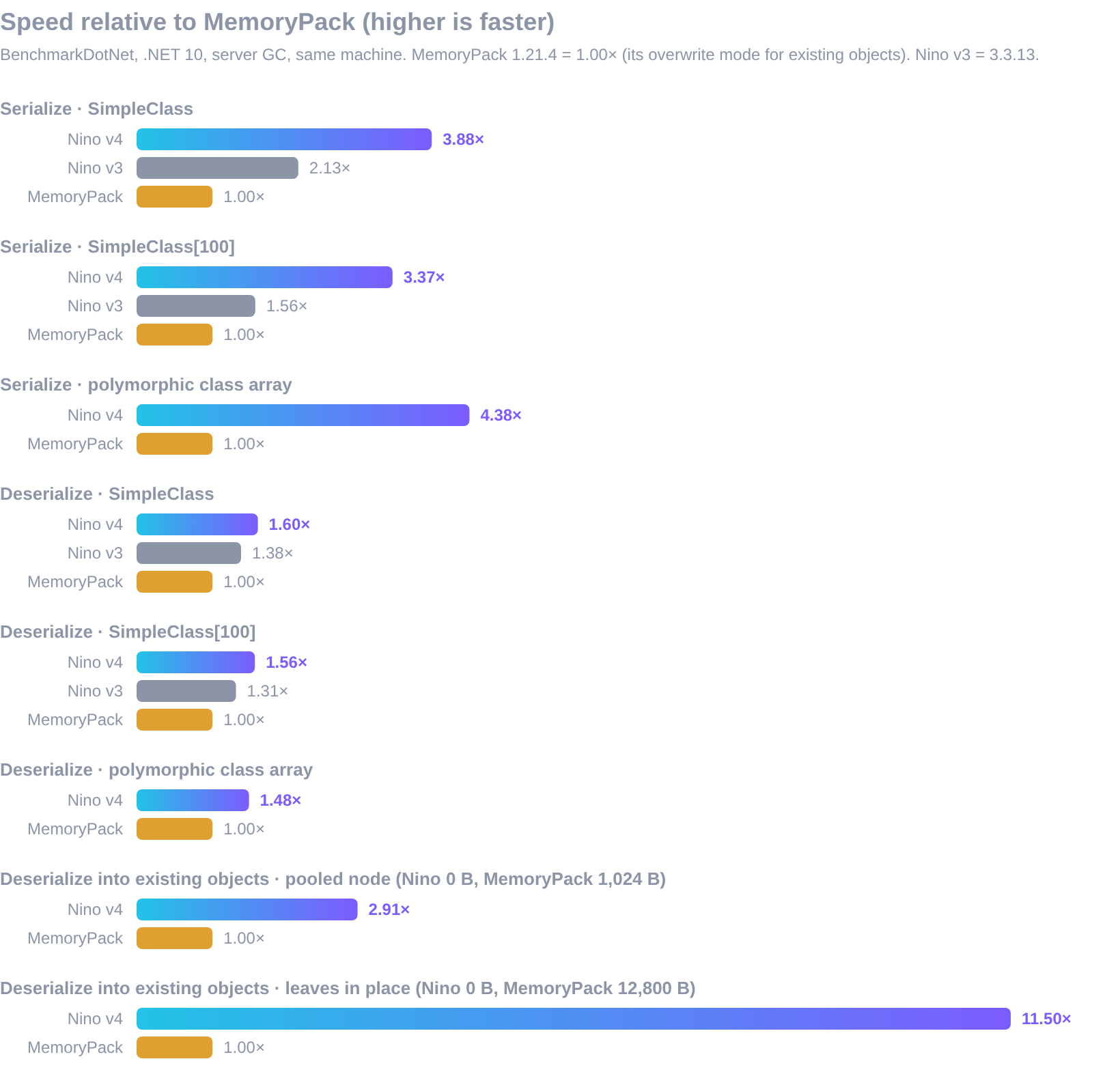
BenchmarkDotNet 0.15.8, .NET 10.0.13, server GC, INTEL XEON PLATINUM 8573C 3.50 GHz; Nino v4 and MemoryPack 1.21.4 in one run, Nino 3.3.13 from NuGet directly before it on the same machine. Payloads are about the same size (SimpleClass: 1,104 bytes in v4, 1,152 in v3, 1,148 in MemoryPack). Every case and the method: docs/v4-benchmarks.md; the notes of each release carry that release's numbers.
- Faster than MemoryPack. Serializing classes and polymorphic types is 3.5–6.8× faster. Deserializing them is 1.3–1.9× faster, and raw struct arrays are at least on par (a block copy in both).
- Safe for untrusted data. Crafted bytes cannot crash the process, allocate out of proportion to their size or make
Nino create a type you did not declare; every invalid input throws one
NinoDataException. Untrusted data. - Zero allocation. Serializing into a buffer (
IBufferWriter<byte>) allocates nothing. Deserializing into existing or pooled objects ([NinoPooled], reuse deserialization into existing objects) allocates nothing either (a string whose text is unchanged is kept), and is up to 8.7× faster than MemoryPack's overwrite mode. - Everything happens at compile time. A source generator writes each formatter. There is no reflection, no IL emit, no registration and no init call, so it works on IL2CPP, NativeAOT and HybridCLR hot updates; Nino.Core is annotated for trimming and Native AOT. With the .NET 8 SDK or later, calls are intercepted to the exact formatter, with no virtual call.
- Fast to build. The generator is incremental: one file per type, and only the type you edit is re-generated. Compared with v3, the generated code is 14× smaller and compiles 51× (330 types) to 221× (1,100 types) faster.
- Thread-safe. Serialize and deserialize from any number of threads, with no locks on the hot path.
- Polymorphism without tags. A value declared as a base class or interface (abstract or not, generic or not) is read back as its runtime type. Type ids are derived from type names, so there is no tag table to maintain, and subtypes in other assemblies (plugins, HybridCLR hot updates) are found on their own. Polymorphism.
- Data that evolves. Version tolerance, keyed members, and reference tracking for shared references and cycles. All are opt-in per type, so types that don't use them pay nothing.
- One format everywhere.
netstandard2.0,netstandard2.1,net8.0andnet10.0write identical bytes on CoreCLR, Mono and IL2CPP, 64-bit and 32-bit, x64 and Arm64, so a Unity client and a .NET server talk to each other directly. - The types you already use. Primitives, strings, tuples, every BCL collection,
BigInteger,Uri,Version,Memory<T>,ILookup<,>,Lazy<T>and more, every immutable collection (Nino.Immutable), Unity'sAnimationCurve,GradientandRectOffset, your own collection types, and anything else through a pluggable formatter. Supported types. - ASP.NET Core, TypeScript, Go and Rust. Nino.AspNetCore
adds MVC formatters and Minimal API bodies and results for
application/x-nino; Nino.TypeScript generates TypeScript codecs for your types after each build, so browsers and Node read and write the same bytes as .NET; and thenino-gentool (Nino.Codegen) writes your types as TypeScript, Go or Rust from a built assembly, for the runtimes inruntimes/(docs/codegen.md). - Mistakes caught while you type. 27 analyzer diagnostics (NINO001–NINO027), many with a one-click fix.
| ⚙️ Services & IPC | Compact binary payloads, no per-call allocations, and safe concurrent use from ASP.NET Core, workers and actors. Nino.AspNetCore reads and writes application/x-nino bodies in MVC and Minimal APIs. |
| 🧩 Web & Node clients | Nino.TypeScript generates TypeScript classes and codecs for your [NinoType]s after each build, so browsers and Node read and write the same bytes as .NET. |
| 🌐 RPC & networking | Serialize straight into an IBufferWriter<byte> (a PipeWriter, a pooled buffer), deserialize from a ReadOnlySpan<byte>, and reuse pooled message objects. Polymorphic messages need no tags, and a crafted message throws one exception instead of taking the server down. |
| 📨 Message queues & event streams | Polymorphic event types behind one base type, small payloads, and formats that let producers and consumers upgrade at different times. |
| 🗄️ Caching | Values for Redis, IDistributedCache/HybridCache or in-process caches, with schema changes across deployments. |
| 💾 Persistence & storage | Version tolerance and keyed members let you add, reorder and remove fields across releases. Reference tracking keeps object graphs with shared references and cycles. |
| 🎮 Unity | Unity 2022.3+, Mono and IL2CPP, HybridCLR hot-update assemblies. Vector3, Quaternion, Color32 and other unmanaged structs are copied as raw memory; AnimationCurve, Gradient and RectOffset are built in. Install from OpenUPM. |
| 👾 Godot 4 (.NET) | A regular NuGet package for Godot's .NET projects. Godot's math structs (Vector3, Transform3D, …) are unmanaged and copied as raw memory. |
New to Nino? Follow Getting Started on the website: installation for .NET, Unity and Godot, your first type, and the basics.
dotnet add package Nino --prerelease            # .NET, Godot
dotnet add package Nino.Immutable --prerelease  # optional: System.Collections.Immutable types
dotnet add package Nino.AspNetCore --prerelease # optional: ASP.NET Core MVC formatters and Minimal API bodies
dotnet add package Nino.TypeScript --prerelease # optional: TypeScript codecs for browsers and Node, after each build
dotnet tool install -g Nino.Codegen --prerelease # optional: nino-gen, your types as TypeScript, Go or Rust
openupm add com.jasonxudeveloper.nino           # Unity (generator and Unity class formatters included)
Nino brings in the runtime (Nino.Serialization) and the source generator (Nino.Generator). Nino v4 is a
prerelease, so --prerelease is required: without it NuGet installs 3.9.x, which cannot read or write v4 data.
using Nino.Core;

[NinoType]
public class Order
{
    public long Id;
    public string Customer;
    public List<OrderLine> Lines;
}

byte[] bytes = NinoSerializer.Serialize(order);
Order copy = NinoDeserializer.Deserialize<Order>(bytes);[NinoType] public abstract class Message { public int Seq; }
[NinoType] public sealed class Ping : Message { public long SentAt; }
[NinoType] public sealed class Chat : Message { public string Text; }
byte[] bytes = NinoSerializer.Serialize<Message>(new Chat { Text = "hi" }); // declared as the base: a type id is written
Message msg = NinoDeserializer.Deserialize<Message>(bytes); // a Chat again: the type id picks the subclassSerialize and deserialize through the common [NinoType] base (not object): generated code dispatches on the type id,
and reuse deserialization and pools work with it. SerializeBoxed/DeserializeBoxed exist only for a type known
only as a Type at run time that shares no [NinoType] base with the others.
// Serialize into the socket pipe: one copy from a pooled per-thread buffer, no byte[] allocated.
NinoSerializer.Serialize(msg, pipeWriter);

// Reuse pooled instances (and their lists) instead of allocating new ones.
[NinoType, NinoPooled]
public sealed partial class ReadingBatch
{
    public long Sequence;
    public List<SensorReading> Readings;

    private static partial IEnumerable<ReadingBatch> OnNinoPoolWarmup() => Enumerable.Range(0, 16).Select(_ => new ReadingBatch());
    private partial void OnNinoPoolReturn() { }
}

var batch = NinoDeserializer.Deserialize<ReadingBatch>(span); // taken from the pool
// ... process it ...
batch.ReturnToPool();[NinoType(format: NinoFormat.Keyed)] // members are matched by name: add, reorder, remove or rename them
public class Profile { [NinoFormerName("Mail")] public string Email; public string Name; }
[NinoType(trackReferences: true)] // shared references and cycles survive a round trip
public class Node { public string Name; public List<Node> Links; }Read the documentation on nino.xgamedev.net →, including advanced guides for high-performance serialization, networking, ASP.NET Core, TypeScript clients, message queues, caching, persistence and Unity.
Besides speed, the clearest difference is untrusted input. MemoryPack's README now calls it "a high-performance serialization format for trusted data only" and no longer recommends it "where the input can come from an untrusted party, such as public network endpoints or user-supplied files" (MemoryPack README). Nino is built for that input: lengths and allocation are bounded by the bytes received, the stack by a depth limit, the data names no types, and every invalid input throws one exception (details).
| Nino v4 | MemoryPack 1.21.4 | |
|---|---|---|
| Untrusted input | built for it: bounded allocation and stack, one exception type | trusted data only, per its README |
| Serialize classes and polymorphic types | 3.5–6.8× faster | |
| Deserialize classes and polymorphic types | 1.3–1.9× faster | |
| Raw struct arrays | at least on par (a block copy in both); v4 zeroes padding, so declare hot structs without it | copies padding as is |
| Deserialize into existing objects | 0 B, up to 8.7× faster (in place) | overwrite mode, allocates |
| Polymorphism | automatic type ids, any base class or interface, generic bases included | [MemoryPackUnion] tags you maintain, on interfaces and abstract classes, not on generic types |
| Keyed members, reference tracking, object pools | ✅ | version tolerance and circular references, no pools |
| Unity | ✅ 2022.3+, one OpenUPM package, netstandard2.0 and 2.1, HybridCLR without an init call |
✅ 2022.3.12f1+, NuGetForUnity plus a git package, netstandard2.1 |
We round-trip every value through MemoryPack 1.21.4 before timing it. These fail (details):
BigIntegerof up to 255 bytes reads back as another value, on every runtime: its formatter writestemp.Slice(written)of its stack buffer wheretemp.Slice(0, written)is meant.BitArrayon .NET 10 is written wrong, and reading it corrupts the heap and crashes the process: the formatter reinterprets it with .NET 8's field layout, which .NET 10 changed.- Tuples of unmanaged items between runtimes:
(1, 2L)written on .NET reads back as(2, 1)on Mono and in Unity, becauseValueTupleis laid out differently there and MemoryPack copies its memory, padding included.
Nino writes all three by their values, not by the runtime's private layout, so they round-trip everywhere.
MemoryPack still has System.Type (left out of Nino on purpose: data that names the types to create is an attack
vector). Nino.TypeScript generates TypeScript from the layouts the formatters are generated from, after each build,
structs and version-tolerant types included
(compared with MemoryPack's,
which its README says will be removed in its next release),
and Nino.AspNetCore adds MVC formatters and Minimal API bodies; browser clients can also run the same C# types on
.NET WebAssembly. Streams, async I/O, multi-segment
ReadOnlySequence<byte> input, callbacks and compression are a few lines around Nino's IBufferWriter<byte> and
ReadOnlySpan<byte> APIs; the full comparison has examples.
MemoryPack's union tag is 1 byte where Nino writes a 4-byte type id, and that is a trade: the id is derived from the
type, so subtypes need no tags, can be added in any assembly (a plugin or a HybridCLR hot update) and never renumber,
while every MemoryPack union lists or registers its subtypes by hand.
v4 is a rewrite of the runtime and the generator. Its binary format is not compatible with v3.
| v4 vs v3 (3.3.13) | |
|---|---|
| Serialize | 1.79× faster (class), 2.29× faster (class array), faster (struct, too fast to measure: under 1 ns), 1.13× faster (struct array) |
| Deserialize | 1.21× faster (class), 1.21× faster (class array), on par (struct), 1.07× faster (struct array), while adding reference tracking, reuse deserialization and payload validation |
| Compiling the generated code | 51× faster at 330 types (42.9 s → 0.84 s), 221× faster at 1,100 types (462 s → 2.1 s) |
| Running the generator | 3.1× faster; after an edit, only that type is re-generated (8.3× faster) |
| Generated code | 14× smaller source, 5× smaller IL |
New in v4:
- Untrusted data: bounded allocation (at most 16× the bytes left ahead of the elements) and stack depth,
one
NinoDataExceptionfor every invalid input, bytes Nino never writes rejected, a bound on hash collisions,NinoSettings.MaxDepth,MaxCollectionLengthandUntrusted, checked with fuzzed and hand-crafted payloads. - Formats: version-tolerant and keyed types, reference tracking, and the wire layout of every type published as
[assembly: NinoTypeLayout]metadata, so a change in the bytes shows up between builds. - Allocation: reuse deserialization into existing objects,
[NinoPooled]pools,[NinoFactory], andNinoArrayBufferWriter, which can rent from your ownArrayPool<byte>. - Types: pluggable formatters (
[assembly: NinoFormatter(...)]), user collection types,BigInteger,Uri,Version,StringBuilder,BitArray,CultureInfo,TimeZoneInfo,Lazy<T>,Memory<T>,ReadOnlySequence<T>, read-only and concurrent collections,ILookup,BlockingCollection<T>,PriorityQueue(.NET 8+), every immutable collection (Nino.Immutable) and Unity'sAnimationCurve,GradientandRectOffset(Nino.UnityTypes, in the Unity package). - Speed: interceptors, inlined struct formatters, block copies for arrays and collections of raw structs,
tuples and
KeyValuePairs, and SIMD on AVX-512, AVX2, Arm64 and WebAssembly; releases are benchmarked on x64 and Arm64. - Platforms: identical bytes on every target framework, runtime and CPU, trimming and Native AOT annotations,
assemblies that unload with a collectible
AssemblyLoadContext(NinoRegistry.Removebefore .NET 8), and HybridCLR without an init call. - Strings: text whose chars are all at most U+00FF (ASCII, Latin-1) is written in one byte a char, other text as
UTF-16, and
[NinoUtf8]writes UTF-8 per member. - Integrations: Nino.AspNetCore (MVC formatters, Minimal API
NinoBody<T>andNinoResults), Nino.TypeScript (TypeScript classes and codecs for browsers and Node, generated after each build) andnino-gen(Nino.Codegen: the same types and codecs in TypeScript, Go or Rust, from a built assembly). - Tooling: an incremental generator and 27 analyzers (NINO001–NINO027) with code fixes, in Unity too.
See what's new, the changelog and the migration guide; internals are in docs/v4-design.md.
Issues and pull requests are welcome. CONTRIBUTING.md covers building, the test matrix and releasing.
MIT License · Made by JasonXuDeveloper